




The most expensive bottleneck in your shop takes up no space
The queue you can’t walk past
Every Monday somebody asks engineering where the job is. Engineering says it is close. Both people are telling the truth, and neither of them has a number.
This is not a discipline problem. Production inventory is visible. You can walk the floor and see the parts stacked against the wall, and nobody has to be told if the shop is behind. Office inventory takes up no space. A drawing waiting for an approval, an RFI sitting in somebody’s inbox, a job that is ninety percent detailed and has been for two weeks: all of it occupies exactly zero square feet. You cannot walk past it, so you manage it by asking, and the answer you get back is always some version of busy.
Busy is not a measurement. It is the same answer whether engineering is two days behind or five weeks behind, and by the time the difference shows up on the floor, the release date has already moved.
What INNERGY already tracks
Engineering time is measurable, and most shops never measure it. In INNERGY, drafting is a work order phase, the same as Production and Installation, so every drafting work order carries a start date, a critical date, a duration and a progress figure.
Date Management is where that stops being a per-job question. It is a single grid of every work order milestone across every project, and it separates four things most shops keep in one column: the Target Date the system calculates, an Override Date a human typed in on purpose, the Actual Date the milestone was really hit, and the Prevailing Date, whichever of those currently governs. Two columns beside them, Days In Step and Days Overdue, do the work of the Monday meeting without anyone having to answer for themselves.
Sorting that grid by Days In Step is the uncomfortable part. The jobs that surface are rarely the ones anybody was worried about. The loud job has been loud for a reason and somebody is on it. The job sitting in the same step for nineteen days is quiet, which is exactly why nothing has happened to it.
One number for the month
Individual milestones tell you where a job is. They do not tell you whether the month is going to make it. That is the Released % metric: released hours divided by total hours, measured against a release step you configure. It answers one question, which is how much of the work in front of you is clean and gone to the floor, versus still being drawn.
The Bottlenecks dashboard puts that in context. Its Workflow and PM in Workflow tabs cross-tabulate hours, cost and margin against time ranges, so you can see whether the engineering queue is a spike this month or the shape of your operation. The Throughput and Slippage widgets sit alongside it, and Slippage drills down to which project managers contributed to the move.
There are honest limits. The measurement is only as good as the release step you set, and if that step does not match what your shop actually treats as released, Released % will be precise and wrong. There is also the question of what counts. Across INNERGY platform data, a cross-tenant rollup built in August 2026, 54.2% of hours attributed to engineering are being worked and 45.8% are waiting, and the largest single waiting bucket is work out for approval. Whether that time should count against engineering at all is a judgment call worth roughly four points either way. Your leadership team makes that call, not the software.
Why we are going to Bonita Springs
This is a hard conversation to have in a group webinar but an easy one to have across a table, which is the real reason we go to the AWI Annual Convention.
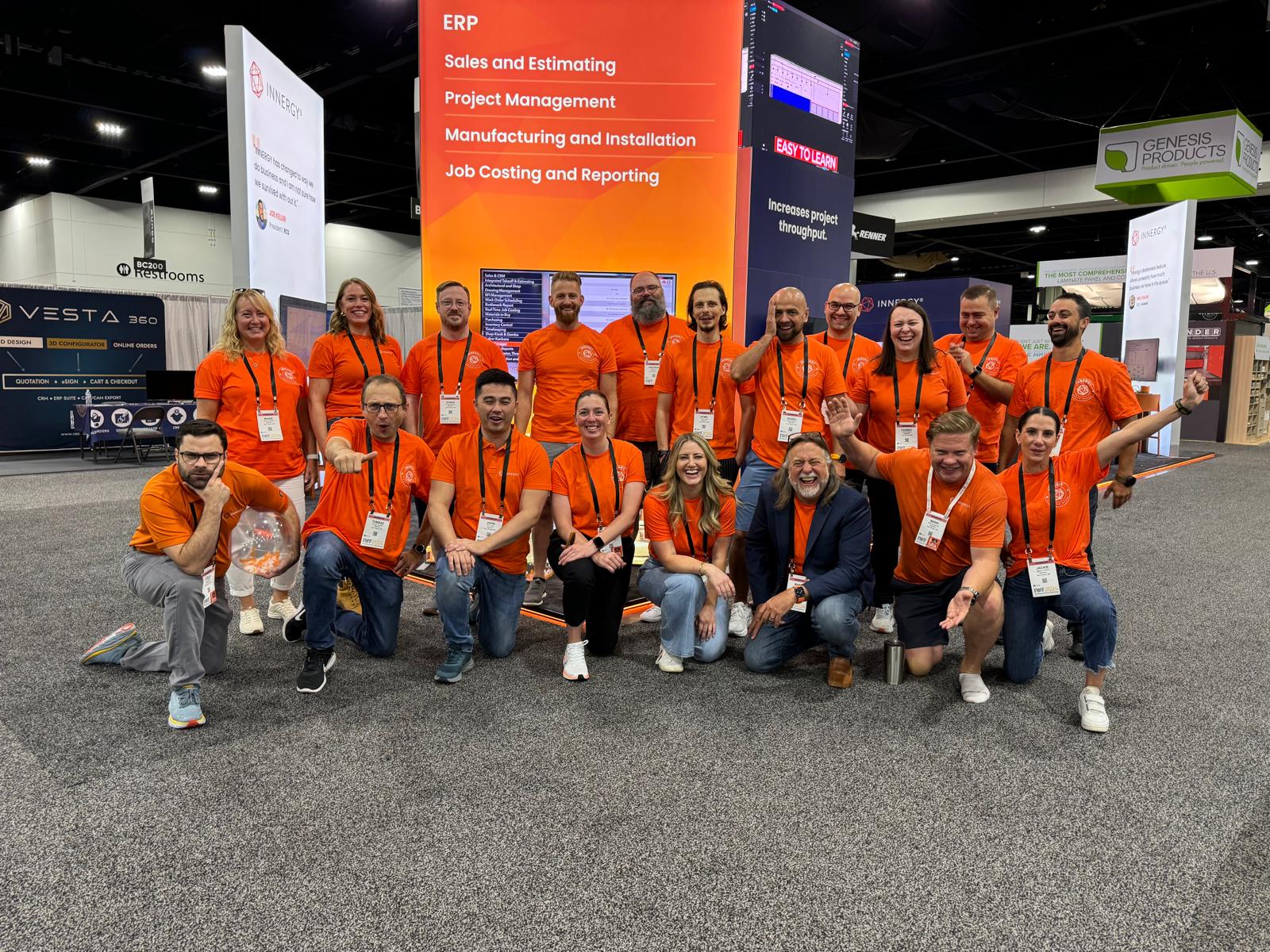
INNERGY will be at the 2026 convention, October 21 to 23, at the Hyatt Coconut Point in Bonita Springs, Florida. Jillian Klinar, Garin Trimble and I are making the trip. Find us at the Product Fair: two six-foot tables side by side, two screens running, no theater presentation on a loop.
Fifteen minutes is enough to see what the measurement looks like on a real operation: how long a job sits between award and released shop drawings, how much of a month is actually released, and what the grid surfaces when you sort it by the jobs nobody was worried about.
What we will not do at that table is tell you the software fixes a throughput problem. It makes the constraint visible, and visible is where a team can finally act. The deciding is still yours, and any vendor promising otherwise is selling you the easy version of a hard year.
Register for the event here and come see us in Bonita Springs. We will be the ones with two screens and too much coffee.